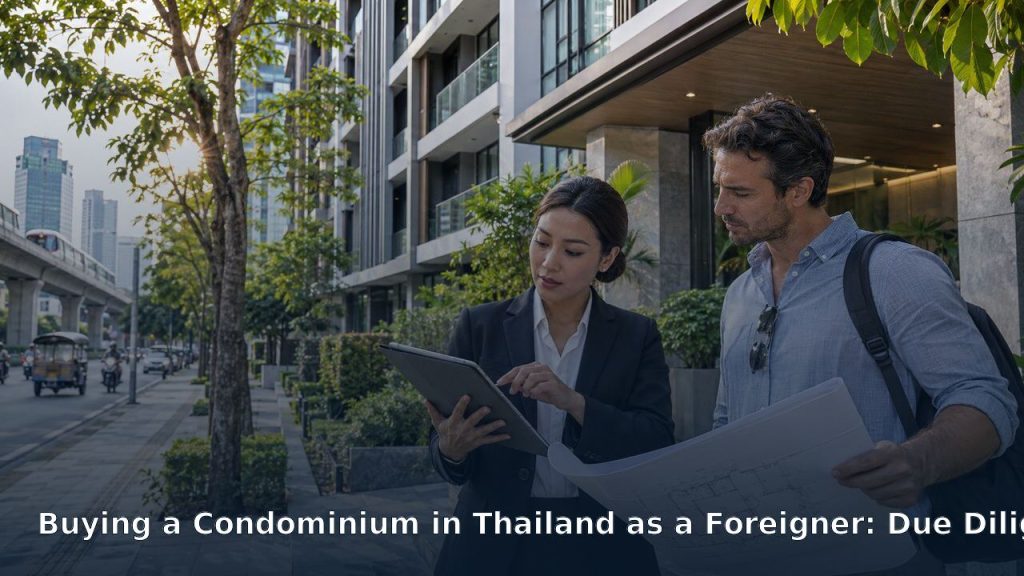
Thailand allows foreign condominium ownership under defined conditions, but every purchase still requires independent verification.

Confirm eligibility
Check the building’s foreign ownership quota and the specific unit’s legal status. Do not assume a developer’s general statement confirms your transaction.
Verify title and funds
Review title, mortgages, restrictions and evidence required for foreign-currency funds. Banking documents can be important for registration.
Study the building
Inspect common areas, sinking fund, maintenance charges, insurance, financial health, management quality and planned repairs. Rental projections should be tested against actual rules and demand.
Calculate exit cost
Include transfer fees, taxes, agent commissions, furnishing, vacancy and resale liquidity. Use an independent qualified lawyer rather than relying only on the seller’s representative.
Rules and prices change. Confirm current requirements with the responsible authority and obtain advice suited to your nationality, family and activity.
Worked example: Bangkok lifestyle plus legal status
A family might start with the 2026 crowd-sourced Bangkok benchmark of about THB 86,000 per month excluding rent, then test a three-bedroom home, school, insurance and annual travel separately. A person who actually qualifies for Thailand’s LTR route should also record the official THB 50,000 issuance fee. Do not put that fee into the model until eligibility has been checked; many attractive visa headlines apply only to narrowly defined income, asset, employer or professional profiles.
Separate the property from the legal right
A building photograph does not explain what the buyer or tenant legally receives. Freehold, condominium title, right of use, long lease and shares in a company are different rights with different expiry, transfer and enforcement risks. The first due-diligence document should therefore be a written description of the right—not a yield projection.
For Indonesia, official land rules recognize right of use for qualifying foreigners, while property type, residence status, minimum values and local implementation still matter. Thailand has its own condominium quota and foreign-funds evidence. Malaysia and Singapore apply separate foreign-purchaser rules, duties and approval systems. Never transport a legal assumption from one country to another.
Build the complete transaction budget
Add taxes, notary or lawyer, registration, agent commission, furnishing, service charge, sinking fund, insurance and initial repairs. For an investment unit, model vacancy, management commission, platform fees, cleaning, utilities, replacement furniture and income tax. Run a conservative case using lower occupancy and a future resale discount.
Physical checks matter as much as title
Inspect water, structure, fire safety, drainage, access, noise, sunlight, mould, building management and planned construction nearby. Visit after rain and at night. For a lease, photograph inventory and define deposit return, maintenance and early termination. For a purchase, use professionals who are independent of the seller and marketing agent.
Red flags
- Pressure to pay before the title and seller authority are verified.
- A nominee structure designed to hide the beneficial owner.
- Guaranteed returns without audited operating evidence or security.
- A long lease with unclear renewal, transfer or dispute language.
- Claims that buying automatically guarantees residence.
Numbers to put into your planning sheet
| Item | Planning figure | How to use it |
|---|---|---|
| Thailand LTR issuance | THB 50,000 | Official fee after qualification approval |
| Bangkok family, excluding rent | About THB 86,000/month | 2026 crowd-sourced planning estimate |
| Bangkok 3-bedroom outside centre | About THB 27,000/month | Citywide average; district and building vary |
Estimates are dated November 2026 and are deliberately shown as ranges. Schooling, insurance, nationality, neighbourhood and lifestyle can change the result materially.