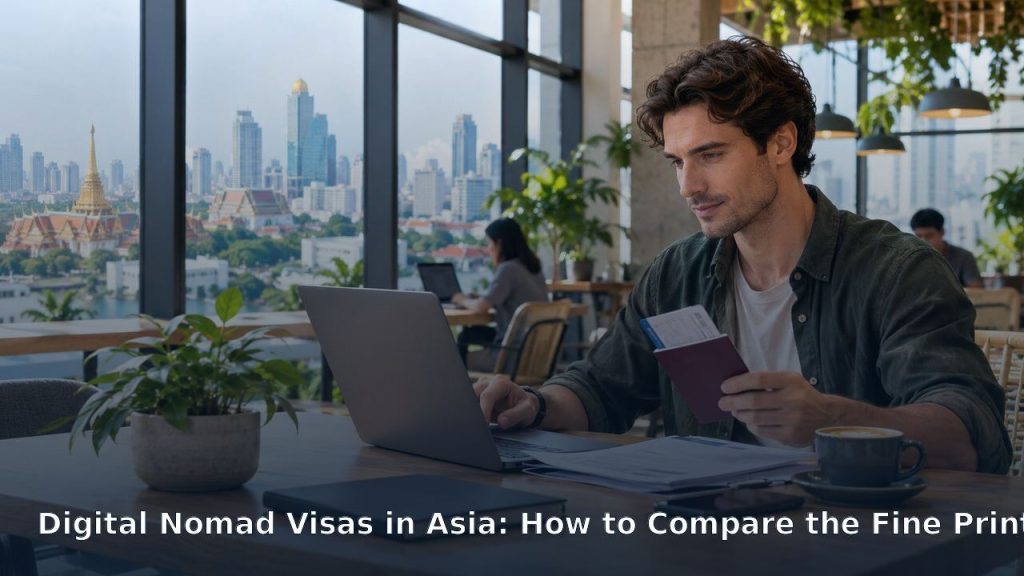
“Best city” lists are useful for inspiration but rarely match an individual’s legal and financial reality.

Start with legality
Remove cities where you cannot obtain a suitable residence status or legally conduct the intended work. This prevents lifestyle preferences from hiding a fundamental problem.
Score infrastructure
Assess home internet, backup connectivity, coworking, electricity, airport access, healthcare and banking. Test the actual neighbourhood rather than relying on city averages.
Calculate complete cost
Include visa, insurance, tax help, workspace, flights, deposits and international-school costs. A low-rent city may not be inexpensive for a foreign family.
Match time and life
Consider client time zones, climate, air quality, language, community and travel to family. Use weighted scores and spend a trial month before making a long commitment.
Rules and prices change. Confirm current requirements with the responsible authority and obtain advice suited to your nationality, family and activity.
Worked example: a remote-work file that can survive review
An applicant considering Indonesia’s E33G route should assemble the foreign employment agreement, evidence of at least USD 60,000 annual income, and a recent three-month statement showing at least USD 2,000—then reserve IDR 7,000,000 for the published one-year government fee. The same person should separately track days in Indonesia because passing 183 days in twelve months can affect tax status. Immigration eligibility and tax residence are related questions, not one question.
Remote work still happens somewhere legally
A foreign employer and an overseas bank account do not make immigration and tax questions disappear. The country where a person lives can regulate permitted activity, while the employee’s presence may create payroll or corporate-presence questions for the employer. The correct analysis starts with the actual work pattern: who pays, where clients are located, who signs contracts and how long the person will remain.
Indonesia’s official E33G route is unusually specific: it is intended for work performed remotely for a company outside Indonesia, lists a USD60,000 annual-income threshold, requires a recent bank statement showing at least USD2,000 and carries an official one-year fee of IDR7,000,000. It does not authorize receiving payment from Indonesian persons or entities. Malaysia’s DE Rantau and Thailand’s LTR categories have different eligibility and fee structures; they are not interchangeable “nomad visas.”
Tax residence needs a separate review
Indonesian guidance states that a foreign citizen may become a domestic tax subject by residing in Indonesia, exceeding 183 days in twelve months, or showing an intention to reside. A visa label does not itself settle treaty residence or the treatment of foreign income. Keep a travel-day record and obtain advice before the first filing deadline, not after a bank asks for tax information.
Operational checklist
- Keep employment contracts and foreign-company evidence current.
- Confirm that health insurance covers the country of residence.
- Use secure internet and an appropriate work address.
- Ask the employer about payroll, data and permanent-establishment risk.
- Maintain an exit reserve and alternative residence plan.
Numbers to put into your planning sheet
| Item | Planning figure | How to use it |
|---|---|---|
| Housing reserve | 3–6 months of rent | Include deposit, temporary stay and setup |
| Emergency reserve | 6–12 months of core spending | Keep accessible and separate from company capital |
| Annual compliance | Budget separately | Visa, insurance, accounting and travel do not fit a rent-only comparison |
Estimates are dated November 2026 and are deliberately shown as ranges. Schooling, insurance, nationality, neighbourhood and lifestyle can change the result materially.