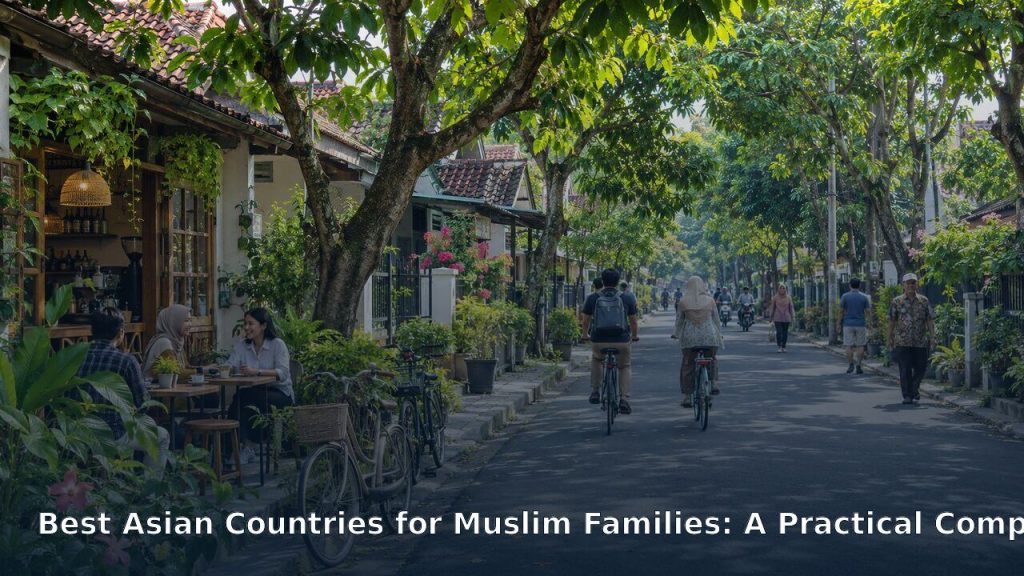
Muslim families often compare countries through halal food alone, but long-term comfort also depends on legal residence, education, healthcare and community.

Indonesia and Malaysia
Both provide broad halal access and large Muslim communities. Malaysia offers widespread English in many urban services; Indonesia provides enormous cultural variety and a large domestic market. City and neighbourhood still matter.
Singapore and Thailand
Singapore has established halal certification and strong infrastructure, but high housing and school costs. Thailand has Muslim communities and halal access in many areas, though availability varies by location.
Gulf alternative
Dubai offers convenient Muslim life and international services, but residence is often connected to employment, business or property conditions, and annual family costs can be substantial.
Family checklist
Verify school curriculum, prayer access, healthcare, insurance, residence stability, family sponsorship and total annual expense. Visit the actual neighbourhood rather than judging the whole country from tourism content.
Rules and prices change. Confirm current requirements with the responsible authority and obtain advice suited to your nationality, family and activity.
Worked example: calculate the school-day cost
Combine tuition with application, registration, capital levy, uniform, meals, devices, activities and transport. Next, value the daily journey: a ninety-minute round trip across 180 school days consumes 270 family hours each year. A higher rent close to the right school can be cheaper when transport, stress and lost work time are included.
How to make a fair country comparison
Country rankings are starting points, not decisions. Compare the legal route first, because a low-cost lifestyle is irrelevant when the intended work or residence cannot be maintained. Then compare one complete household standard: similar housing quality, school type, healthcare expectation, transport and international travel.
Use city-level evidence. Indonesia alone contains global-business districts, industrial cities, tourism markets, cooler highlands and remote islands. Malaysia, Thailand and Vietnam have similar internal differences. A country average can hide the neighbourhood conditions that shape every weekday.
Build three scenarios
The base case should reflect normal income and spending. The stress case adds a medical event, currency decline or job interruption. The exit case estimates the cost and time needed to leave a lease, close or maintain a company, move children and relocate possessions. Good decisions survive all three.
Visit as a resident
Stay in an ordinary home, travel at peak hour, buy groceries, test internet, visit schools and hospitals and experience rain or heat. Speak with residents who are not selling property, visas or relocation services. Keep written observations so a pleasant holiday mood does not replace evidence.
Decision checklist
- Legal residence and permission for the actual activity.
- Total annual cost including school, insurance and compliance.
- Healthcare access for predictable and emergency needs.
- Time lost to transport and administration.
- Climate, pollution, flooding and long-term resilience.
- Community, language and family support.
Numbers to put into your planning sheet
| Item | Planning figure | How to use it |
|---|---|---|
| Housing reserve | 3–6 months of rent | Include deposit, temporary stay and setup |
| Emergency reserve | 6–12 months of core spending | Keep accessible and separate from company capital |
| Annual compliance | Budget separately | Visa, insurance, accounting and travel do not fit a rent-only comparison |
Estimates are dated November 2026 and are deliberately shown as ranges. Schooling, insurance, nationality, neighbourhood and lifestyle can change the result materially.