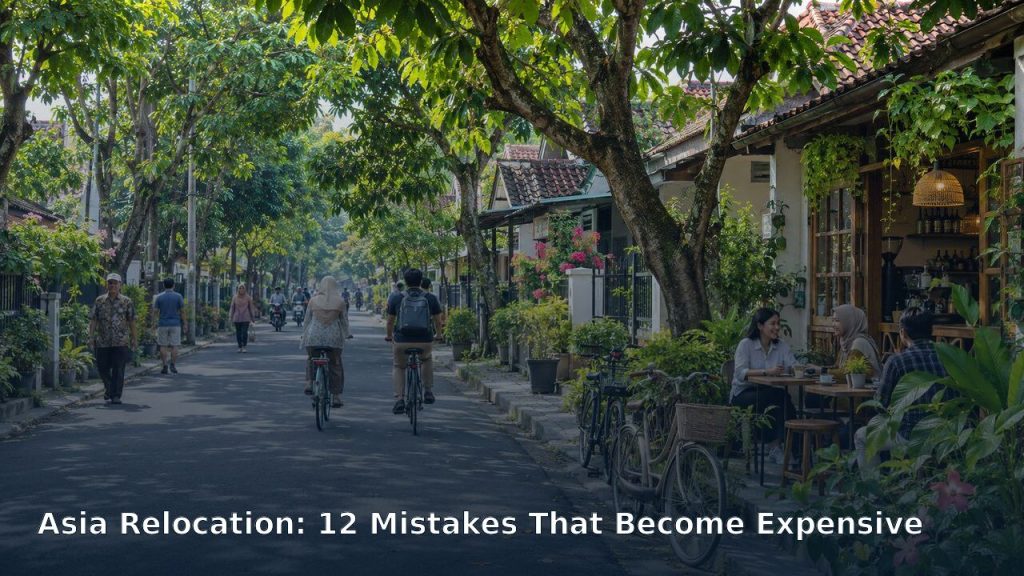
Most relocation problems are not caused by one dramatic event. They grow from assumptions made before arrival.

Before moving
- Choosing a country from holiday experience.
- Assuming a visitor status permits work.
- Budgeting only rent and food.
- Ignoring school waiting lists.
- Buying insurance without reading exclusions.
- Shipping possessions before testing the city.
After arrival
- Signing a long lease immediately.
- Paying combined “government fees” without itemization.
- Opening a company without confirming the activity.
- Using informal nominees for assets.
- Ignoring possible tax residence.
- Keeping no emergency or exit reserve.
A better approach
Use a temporary landing period, document every official requirement and compare a full annual budget. Independent advice is cheaper than repairing an unsuitable structure.
Before acting, verify current eligibility, charges and procedures with the responsible government authority or a properly qualified adviser.
Worked example: compare one ordinary Tuesday
Use the same household and income in every country. Price a suitable home, school or workspace, insurance, transport, food, compliance and two annual trips. Then describe an ordinary weekday hour by hour. The place that wins on rent can lose through commuting, unreliable administration or weak legal status; the expensive city may recover value through time and predictable services. Keep the comparison dated and revisit it after a trial stay.
How to make a fair country comparison
Country rankings are starting points, not decisions. Compare the legal route first, because a low-cost lifestyle is irrelevant when the intended work or residence cannot be maintained. Then compare one complete household standard: similar housing quality, school type, healthcare expectation, transport and international travel.
Use city-level evidence. Indonesia alone contains global-business districts, industrial cities, tourism markets, cooler highlands and remote islands. Malaysia, Thailand and Vietnam have similar internal differences. A country average can hide the neighbourhood conditions that shape every weekday.
Build three scenarios
The base case should reflect normal income and spending. The stress case adds a medical event, currency decline or job interruption. The exit case estimates the cost and time needed to leave a lease, close or maintain a company, move children and relocate possessions. Good decisions survive all three.
Visit as a resident
Stay in an ordinary home, travel at peak hour, buy groceries, test internet, visit schools and hospitals and experience rain or heat. Speak with residents who are not selling property, visas or relocation services. Keep written observations so a pleasant holiday mood does not replace evidence.
Decision checklist
- Legal residence and permission for the actual activity.
- Total annual cost including school, insurance and compliance.
- Healthcare access for predictable and emergency needs.
- Time lost to transport and administration.
- Climate, pollution, flooding and long-term resilience.
- Community, language and family support.
Numbers to put into your planning sheet
| Item | Planning figure | How to use it |
|---|---|---|
| Housing reserve | 3–6 months of rent | Include deposit, temporary stay and setup |
| Emergency reserve | 6–12 months of core spending | Keep accessible and separate from company capital |
| Annual compliance | Budget separately | Visa, insurance, accounting and travel do not fit a rent-only comparison |
Estimates are dated November 2026 and are deliberately shown as ranges. Schooling, insurance, nationality, neighbourhood and lifestyle can change the result materially.