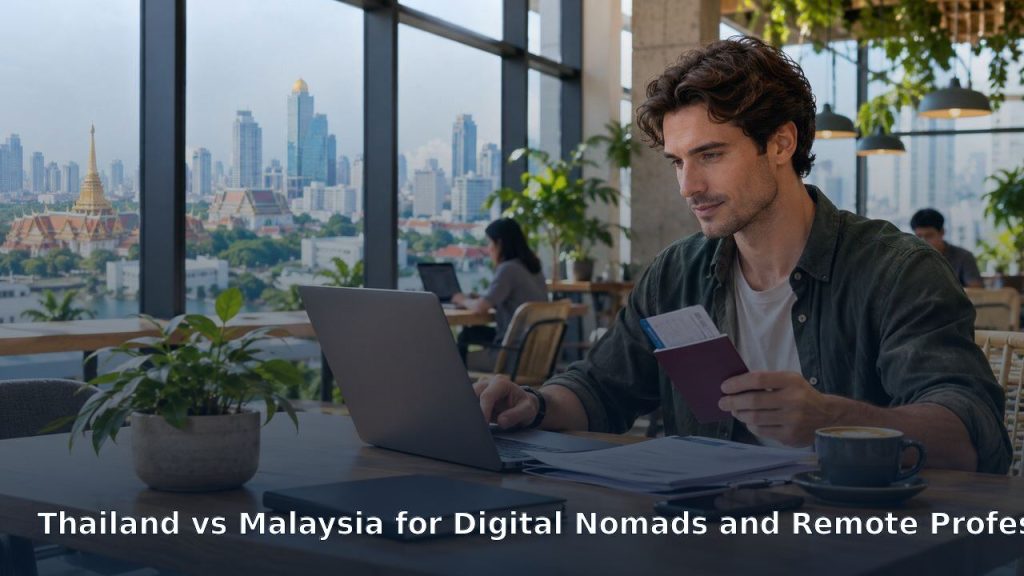
Thailand and Malaysia are popular remote-work bases, but a comfortable coworking space does not answer immigration or tax questions.

City and work environment
Bangkok and Chiang Mai provide large digital communities and abundant short-term accommodation. Kuala Lumpur and Penang offer widespread English, strong connectivity and practical regional flight access. Internet quality is usually good in established urban areas, but housing checks still matter.
Legal status
Confirm whether a visa or residence program permits the work pattern you intend. Do not assume foreign clients make all work lawful on a visitor entry. Employer, payroll and company-management questions may remain.
Healthcare and cost
Both countries have respected private healthcare. Compare insurance, hospital access and annual immigration expenses alongside rent and food.
Choosing between them
Thailand may appeal through lifestyle variety and established remote-worker communities. Malaysia may be easier for people prioritizing English and a concentrated administrative environment. Choose based on legal fit and sustainable annual cost.
Rules and prices change. Confirm current requirements with the responsible authority and obtain advice suited to your nationality, family and activity.
Worked example: price the whole Malaysian year
For a remote professional using DE Rantau, begin with the published RM 1,080 applicant processing fee and RM 540 for each dependent, then add the stated immigration pass charge, any visa charge by nationality, insurance, document work, housing deposit and school. A couple with two dependants would therefore record RM 2,160 in processing fees before those other items. This is a planning example, not a promise of eligibility or approval.
Remote work still happens somewhere legally
A foreign employer and an overseas bank account do not make immigration and tax questions disappear. The country where a person lives can regulate permitted activity, while the employee’s presence may create payroll or corporate-presence questions for the employer. The correct analysis starts with the actual work pattern: who pays, where clients are located, who signs contracts and how long the person will remain.
Indonesia’s official E33G route is unusually specific: it is intended for work performed remotely for a company outside Indonesia, lists a USD60,000 annual-income threshold, requires a recent bank statement showing at least USD2,000 and carries an official one-year fee of IDR7,000,000. It does not authorize receiving payment from Indonesian persons or entities. Malaysia’s DE Rantau and Thailand’s LTR categories have different eligibility and fee structures; they are not interchangeable “nomad visas.”
Tax residence needs a separate review
Indonesian guidance states that a foreign citizen may become a domestic tax subject by residing in Indonesia, exceeding 183 days in twelve months, or showing an intention to reside. A visa label does not itself settle treaty residence or the treatment of foreign income. Keep a travel-day record and obtain advice before the first filing deadline, not after a bank asks for tax information.
Operational checklist
- Keep employment contracts and foreign-company evidence current.
- Confirm that health insurance covers the country of residence.
- Use secure internet and an appropriate work address.
- Ask the employer about payroll, data and permanent-establishment risk.
- Maintain an exit reserve and alternative residence plan.
Numbers to put into your planning sheet
| Item | Planning figure | How to use it |
|---|---|---|
| DE Rantau processing fee | RM 1,080 applicant | Official fee including stated SST in published FAQ |
| DE Rantau dependent processing | RM 540 each | Immigration pass and visa charges are additional |
| Kuala Lumpur family, excluding school | RM 6,150–9,250/month | Planning range; housing choice drives the spread |
| Thailand LTR issuance | THB 50,000 | Official fee after qualification approval |
| Bangkok family, excluding rent | About THB 86,000/month | 2026 crowd-sourced planning estimate |
| Bangkok 3-bedroom outside centre | About THB 27,000/month | Citywide average; district and building vary |
Estimates are dated November 2026 and are deliberately shown as ranges. Schooling, insurance, nationality, neighbourhood and lifestyle can change the result materially.